
9 Longevity Trends for 2026: Age Better, Not Just Longer
Tech, clinical experts and Big Pharma collab to keep you ‘out of hospital’. Women and AI redefine longevity. And ‘bot’ pets are the new ‘Labubus’. Here are the key trends shaping longevity in 2026.

Longevity’s new Life Goal: Stay out of hospital
Longevity science is evolving. From ‘life extension’, the needle is now moving towards ‘life optimisation’ – where living healthier, longer is the new ‘longevity’ goal. And an ecosystem is springing up in support, globally and in India.
Scroll down to get your fix on trends that could shape your longevity journey in 2026.
Looking for an X’mas or New Year’s gift that says ‘I care for you’? Why not share the joy you get from reading Never Too Late? More is always merrier, right?
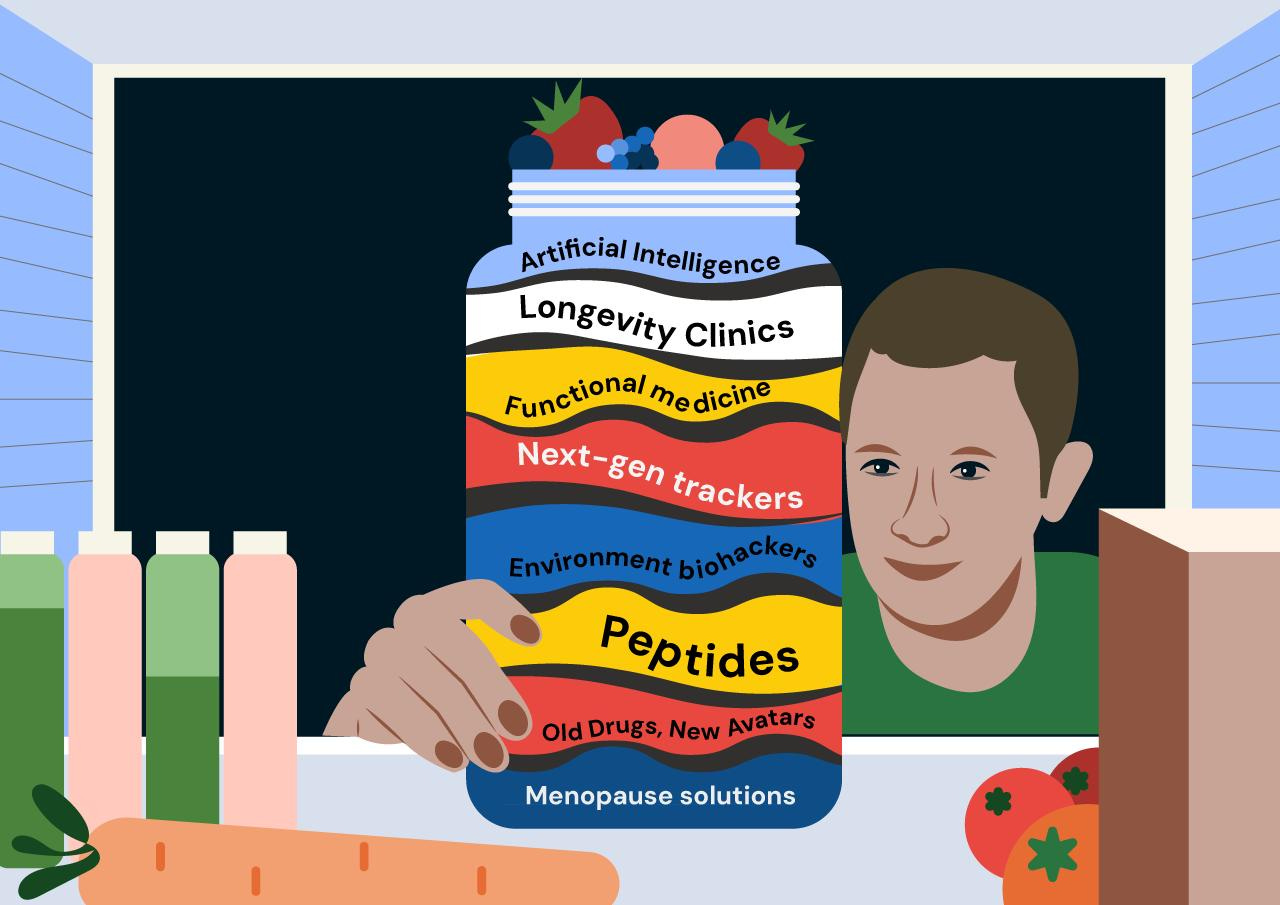
Creative by Anjul D.| Longevity Inc’s new ‘mason-jar’ plan to keep you out of hospital
Trend #1: Results matter, not just data
Still using your smartwatch to merely count your steps? Then you are seriously behind the curve.
As 2025 drew to a close, companies like Whoop, UltraHuman and Function Health all moved towards a ‘digital dashboard’ that combines your daily dynamic data – steps, heart rate etc – with static data from your blood work.
For us, this means a more comprehensive outcome-based solution that we can use to optimise our health.
For the companies themselves, it enables them to collect data, train their in-house AI builds to interpret, analyse and leverage data to deliver targeted results to users. Imagine a targeted program to lower heart risk or metabolic dysfunction with some help from your watch.
“The winner will be the one who proves the strongest health outcomes for either specific clinical cases or specific population sets, like whether it’s women’s health or children’s health or athletes’ health or, you know, non-communicable diseases,” predicts longevity physician and Founder-CEO of HumanEdge, Dr Marcus Ranney.
Incidentally, at his own company, doctors use a ‘digital intelligence layer’ for recommendations based on the digital and blood data that they collect. They have already completed their first health outcome study in 2025.
Trend #2: Trackers to counter slackers (most of us)
Come 2026, uploading a photo of your meal to your health app will get passe. Enter, sophisticated trackers that don’t need you to log every bite or step. And companies are exploring all kinds of clues the body gives to get that data. Like voice, for instance.
“Work is already underway on using your voice as an input to assess biological status and responses,” Kanishka Acharya, Founder and CEO, Welldercare told me.
For the geeks, the tech is called ‘Bio acoustic Resonance for Here and Now evaluation’. For the rest of us – you record a voice sample and that is translated into actual clinical outputs.
In case this sounds too much ‘Black Mirror’ to you, I tried it and the results are quite simply mind-blowing. Expect that tech to roll out next year, in India!
Trend #3: Hacking Health’s ‘X’ factor
Worried about air pollution? Well, that’s been top of mind for most of our innovators as well.
Last year, Anurag Ram Chandran, founder of age tech company Kubo Care told us how solutions like UltraHuman Home allow you to optimise your environment –light, heat, air pollution – like you do your body.
This year, Anurag told me they have incorporated the tech into their fall detection solutions. So, instead of a standalone fall detection device, KuboCare’s gadget now tracks light, humidity, air quality and temperature as well. How does that help us?
“Say if somebody’s tossing and turning a lot in the middle of the night and the temperature or the AQI in the room is high, we send out an alert suggesting how you might change those environmental factors to better suit your conditions,” Anurag explained.
And as 2026 dawns, expect more. As Anurag told me, “The good news is that there are newer startups starting to work on it (air pollution solutions) as well.”
Trend #4: Tech ‘Labubus’ to up your social quotient
Man’s good friends – the dog and the cat – just got robotic avatars. Well, animal bots did have a moment in CES 2025. But, as Anurag remarked, they are becoming more commonplace now. “I’m starting to see a lot more of these, at least in senior living spaces. So, you’ll have like random cats meowing around and then you are reminded that these are in fact, robots.”
Now before you add them to your list for Santa, companion bots of the feline kind are not yet available in India. We will have to wait for this one.
Trend #5: ‘Pep’py Superstars
Know what’s already here? Big Pharma’s latest superstar – Peptides. One peptide formulation we met this year was GLP-1, the ‘weight loss’ drug sold as Ozempic, Wegovy, Mounjaro etc. Come 2026, there will be more.
As Dr Marcus Ranney predicts: “I think commercial availability of peptides like the GLP ones, and many, many more from recovery, endurance, and athletics, will now enter the scene for ‘26.”
The interest in peptides – essentially a short chain of amino acids – Dr Ranney adds, is because of “a group of physicians in the longevity fraternity who believe that there is probably an outsize cardiovascular and metabolic benefit from GLPs.” So yes, if you are already well on your longevity journey, expect to start adding peptides to your supplement stack soon.
But, resist the urge to self-prescribe these drugs. As the doctor also pointed out, peptides “are not always orally bioavailable. They tend to break down when they’re consumed in a capsular format, which is why the vast majority of peptides tend to be injectables.” So, consult your doctor first.
Trend #6: Pharma’s ‘wrapped’ has a ‘Remix’ theme
Immuno-suppresant drug Rapamycin and diabetes med Metformin got their star turn last year as longevity mavens swore by their ‘additional’ anti-ageing benefits. But even as research seeks to find ‘proof of these benefits’, work is already underway to find the next ‘remix’ stars.
Dr Marcus Ranney spoke of a US-based company led by Matt Kaberlain (who led the research on Rapamycin) which has “created a platform where they’re looking at 1 million drug candidates to repurpose for longevity. So, using C. elegans in a dish, using AI in a very fast throughput, they’re looking at almost a million different pharmaceutical candidates to see whether there’s a lifespan extension in C. elegans.
And these are not all new drugs. These are drugs which exist today, which are either being retrofitted or repurposed or they are looking at them in unique combinations,” he said.
Big Pharma’s excitement is obvious – should a drug actually work, it could mean millions of dollars saved and a faster route to market. Question is – given Indian pharma sector’s penchant for reverse engineering molecules, can we expect some company to attempt a ‘Made-in-Bharat’ longevity drug?
Trend #7: The many ages of woman (and man)
I wilfully misquote the Bard here, because that’s what the next big trend in longevity research is all about.
“An aspect that has become very popular in this last one year is to identify organ-specific ageing. If there’s an organ clock which is ageing, research is looking at it,’ Dr Deepak Saini, IISc scientist and Convener, Longevity India Initiative told me.
Why are scientists excited? Because slowing down ageing in an organ should be easier than slowing down ageing in the entire body system. And the ripple effect would benefit overall health.
“There are a lot of studies on ovarian reserve and ovarian ageing now,” Dr Sanjana Rao told me when I asked her what excited her most for 2026. Sanjana is a scientist and co-founder of Miyara, an Indian women’s health start-up.
“The idea of the whole ovarian ageing thing is that we delay menopause to a certain degree. Now you know menopause impacts health span. So, if women could go through menopause slightly later in their life, it’s better for our overall health,” she explained.
Another reason we should be excited about this - Indian women are actually born with fewer eggs than the global average, as Dr Sanjana Rao told me. So, we go through menopause earlier, because the eggs deplete faster. We also spend many more years in poor health.
Unless we act now, like the next trend pushes us to.
Trend #8: Longevity, wrapped up in a bow
This is the trend that ties it all – the trackers, the science, the tech, the drugs and presents it to us as a solution. I am, of course, speaking of the rise of functional medicine practitioners, longevity clinics, functional gyms, wellness and health centres in India.
Led by clinicians or longevity-invested founders, they are all invested in one goal – optimising your health to increase healthspan. Most will give you personalised plans to meet your health goals. But, of course, membership to avail these ‘concierge-style’ services comes at a price. And not everyone is legit out there. Since there is no authorisation these centres need right now to brand themselves as ‘longevity clinics’, best do your research before you pay the fat fees.
The way I look at it – the rise of what Dr. Ranney calls ‘omnichannel approach to health’ is a good thing because these move the needle to preventative medicine rather than just curing disease. Regulation will follow. (Of course, you could D-I-Y it as well, but at the very least, ensure there is a doctor and a physical trainer in your corner).
Whatever approach you choose, the alternative is way more expensive. Take a look.
Trend #9: Insurance pads up to play the long game
Recently, global insurance giant Manulife committed $350 million to set up the ‘Longevity Institute’ focused on ‘research, innovation, and partnerships that will help people thrive at every age’.
It is an investment that makes sound business sense since an insurer would profit if we stay healthier, longer. Closer home, Kanishka Acharya’s Welldercare is already trying to interest insurance companies in outcome-based models.
Kanishka describes this as a ‘conditional policy’ where the consumer signs up for a ‘self-funded longevity or health reversal program to improve their health scores. But if they demonstrate remarkable progress, then the cost of the program is adjusted in the premium. “Now, these are outcome-based models that India is going to see,” he said.
Why should it excite you? Think about it as getting paid to stay in good health, via savings on insurance premiums.
As Kanishka points out, the trend is timed just right, given that recently private equity investments have increased in healthcare. “Private equity companies aren’t churches. They need returns. They will jack up prices per yield. They will drive up cost of healthcare. And that means your conventional 50 lakh cover is not going to do it for you. You’re going to see people needing at least a two crore health cover just to survive,” he said.
To sum, the writing is on the wall. If you are over 40 and those strange aches and pains haven’t convinced you to start investing in your health yet, maybe the potential hit on your pocket will.
After all, the goal is the same – to stay out of hospital.
Now if you are thinking something is missing on this list, it is. And this is not one, but two key trends.
Longevity gets a women-centred, AI-enabled makeover
The Girls gang up
Longevity is not just about the tech bros any more. Women scientists are leading research into women’s health. The recent removal of the FDA black box warning on hormone replacement therapy could be just an indicator of things to come.
“Yes, there are people talking about menopause and perimenopause as if it’s just like some plug-and-play system, but there’s an entire process.
I’m hoping that this helps people come up with new drugs, safer options, safer alternatives. It’s a transition that needs to be supported by better data, better research, better innovation,” Dr Sanjana Rao observed.
In fact, she pointed out that with Miyara, they are already building ‘an India specific data set’. But clearly, menopause is just one piece of the puzzle.
As she pointed out, we need more work and funds to ‘build personalised health solutions’ for fifty per cent of the globe’s population, aka women.
AI or nothing
Dr Ranney calls AI, ‘the big boy in the room’. And for good reason. AI is reshaping everything longevity – from research and drug development, to data analysis and the creation of personalised regimens.
In fact, instances of how scientists/ doctors and innovators are using AI are peppered right through the earlier article in this edition. So, I will not list them separately. But here’s what I can tell you – every expert I spoke to – be it scientist, doctor, innovator, investor – every single person was unanimous that AI still needs a ‘man in the middle’.
Dr Saini put it best: “We always would need a ‘human in the loop’. Somebody who’s a conscience keeper of the AI in terms of healthcare practices. But at the same time, we really need to get high-quality data to be generated to train these context-aware AI models.”
And that data collection is essentially the name of the game in longevity right now.
Data collection is also what is keeping scientists busy as longevity research picks up momentum in India.
Get set for some ‘Made-in-BHARAT’ Longevity solutions
Now we know that the world’s largest longitudinal study has been underway in India with LASI (Longitudinal Ageing study of India). 2025 saw IISc roll out its BHARAT (Biomarkers of Healthy Aging, Resilience, Adversity, and Transitions) study.
Dr Deepak Saini of the Longevity India Initiative is driving the BHARAT study. So I asked him for some insight into its progress.
Here’s what the team has been doing this past year:
Collecting healthy baseline data for India, aka ‘normal’ and ‘optimum’ blood sugar, lipid levels for an Indian cohort.
Exploring the gut-ageing axis.
Developing model systems to mimic ageing in the lab so they can test the impact of different interventions.
“Right now we are sticking to southern states. We will expand it to other states also, but that will be subject to getting enough funding support. We are reaching about a thousand individuals in both rural and urban settings, where we are collecting a lot of metadata about their lifestyle, health history. Molecular analysis has just begun in our labs,” Dr. Saini told me.
Here are some answers they expect to have by end-2026:
A more substantial insight into Indian ageing trajectories.
Some idea about an Indian baseline for various features in our body.
Dr Saini explained: “For example, if the cholesterol changes in healthy ageing Indians too, then maybe we don’t really have to worry. We need to worry, of course, because, uh, if it goes beyond a certain threshold, but it may not be the numbers which we are used to looking from the Western standard. So, I think that kind of clinical decision-making insights we will get from that study by next year.”
The Longevity India Initiative also has an Entrepreneur-in-residence program. Staying true to the spirit of Indian ‘jugaad’, Dr. Saini said we could expect to see “products where low-cost deployment would be the mainstay.”
“A lot of innovation in testing new markers of ageing or health will emerge like new imaging technology, new wearable, new diagnostic tests, new way of recording non-invasive data, all that will come from a lot of these new startups,” he added.
And of course, we already heard from Dr Sanjana Rao how they are collecting data from an Indian women cohort. In fact, 2025 also saw multiple other ageing studies were launched by institutions across the country.
If you ask me, it does seem like we couldn’t have asked for a better time to grow old in India!
Before You Go
Any trend update would be incomplete without what’s trending on social media. And if what we are seeing plays out, 2026 might just ring in happier, friendlier and slower for all of us. Here are some early indicators:
The big one, teens – everyone under 16 - had to go off social media in Australia, thanks to a government directive. Existing accounts were de-activated. New ones can’t be made. Screen-weary adults, meanwhile, are taking notes.
‘Pinterest predicts’ for 2026 predicts that a mix of nostalgia, comfort and self-expression rule through the coming year. Two big search trends that stood out for me – snail mail or handwritten letters are back. And searches for mystic, mist-shrouded woodlands to holiday in are peaking.
And the final signal that 2026 may be all about going slow and making deeper connections – the LIIT is no longer ‘lit’. Pubs are bringing conversation back through lecture clubs and midlifer communities. Intimate supper clubs and musical soirees are redefining what an evening out means.
And if you don’t know what a ‘third place’ is, find out now. Because it will matter to you and your health.
Or better still, keep reading Never Too Late. You will find a ‘third place’ here, next year along with all the other India-focused information you need to live healthier, longer.
See you in 2026!
On that note, I will say goodbye.
I know this was an ‘extra-loong’ edition. I hope it makes up for the fact that there will be no issue next week. In keeping with what we write here, Team NTL will take a break to spend time with family and friends over the year-end.
I will now see you on Monday, 5 January 2026.
Wish you all a happy and healthy new year filled with love and laughter.
Kavita Krishnan.