
The BMW model of longevity costs a fortune. A Nano gets you there too.
Tech bros are burning through millions to live healthier, longer. But evidence shows a budget and time-smart model of longevity can be equally effective.

THE BODY CHOICE
If all you have is a minute
The Crux: Expensive longevity routines — 5am wake-ups, cold plunges, red light therapy, exotic superfoods — are optional, not essential. For Indians in their 40s, a budget and time-smart alternative gets you to the same place. The research backs this up completely.
The Insight:A UK Biobank study tracking ~89,000 individuals found morning sunlight alone could cut early death risk by 17-34%. A hot bath at 40.5°C outperformed both traditional and infrared saunas in cardiovascular and immune benefits. Consistent sleep schedule, morning sun, diverse local food, 150+ minutes of varied movement, daily screen-free time — that is the evidence-based budget model for healthy longevity in India.
What you get: Six tech-bro blueprints mapped to six alternative, evidence-based budget biohacks. Start with whichever one fits your life right now.
Bonus Read: Bryan Johnson spends $2 million a year on longevity. His recent viral letter lists 41 lessons from that experience. None of them require expensive technology. This week’s bonus read is that letter — and it endorses most of the budget biohacks in this article.
Published by Never Too Late · never2late.substack.com · Kavita Krishnan · May 2026
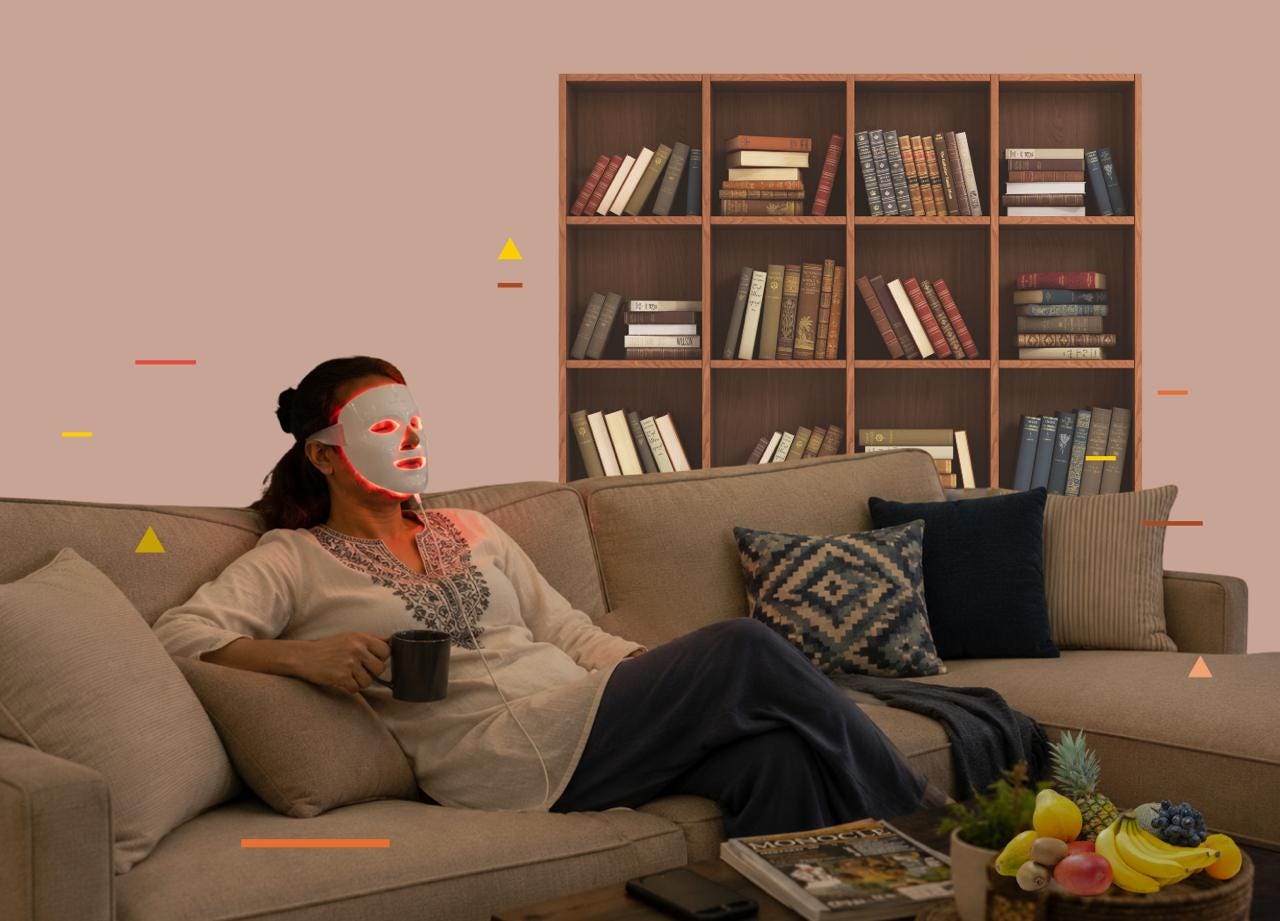
Creative by Anjul D.| Can't afford the mask? The morning sun is free
I do not have a 5am routine.
Sounds blasphemous, I know. Especially when it comes from someone writing a weekly newsletter on longevity and preparing for the 100-year-life.
I don’t subscribe to the 5am club because for me, personally, it is not sustainable.
Let’s be honest here – for most of us, it is not practical. We cannot spend the hours from 5-9am every day, navel-gazing. Our schedules cannot be built around dinner at 11am or cold plunges and sauna sessions. Nor do we have money to burn on supplement stacks, full body scans and blood tests.
Plus, I refuse to believe that the ticket price for a healthy life is this steep.
Which is why I looked at the evidence on most-cited tech bro longevity routines.
What I found: if healthy living is your goal, you can safely hit snooze on what I call the ‘tech-bro model of longevity’.
And make your own realistic, time-smart, ‘budget’ model instead.
This newsletter does one thing — translates the research on healthy longevity for the Indian midlifer. Every Monday.
How to work towards Healthy Longevity on a budget
Time-poor? This evidence-backed routine I have put together should help solve for that too.
1. Bro blueprint: 5am routine
Disclaimer: There is proof that waking up early is good for your health. But, you don’t need membership to the 5am club.
Not when your mornings are a blur of school lunches, stand-and-eat breakfasts, bus-stop runs, schedule-matching with your partner and fielding last-minute curveballs from your kid before heading out the door to work.
In fact, if you are a ‘night owl’ or work late shifts, going against your body clock in the long term could be unhealthy.
This meta-analysis of 27 papers found a clear association between this condition called ‘Social Jet Lag’ and an increase in waist circumference. Two cross-sectional studies it included found that adding up sleep debt could increase your risk of developing metabolic syndrome – a cluster of diseases including Diabetes and Hypertension.
Budget biohack: Sleep early. Build a regular sleep schedule
Going to sleep after midnight impacts how the body manages blood sugar levels according to Chinese researchers who studied the association between sleep (quality and quantity) with blood glucose levels in the general, non-diabetic population. They also found that people who slept between 4 to 7 hours had larger blood sugar spikes and more variability in blood sugar as compared to those who got at least 8 hours of sleep.
In short, sleep and rise like a soldier – at the same time every day, even on weekends. And even if you sleep late, hit the hay before midnight.
2. Bro blueprint: Red and near infrared-light therapy
I get the attraction. Those Stormtrooper-like masks are as sci-fi as you can get. But it is not all woo-woo. Red-light therapy or what scientists call ‘Photobiomodulation’ has been used in treating ailments of the skin long before the longevity crowd discovered it.
In mice, there is evidence it can spur hair growth. In humans, there is some evidence that it helps improve outcomes in wound healing, peripheral neuropathy, retinal degeneration and certain neurological disorders. Research is now shifting focus to how it impacts mitochondria – the cell’s powerhouse.
But the evidence as on date does not match the hype, as scientists point out in this article in the Scientific American. What’s more, the benefits from red light masks, wands, mats etc. that you can buy are still dubious.
Budget Biohack: Get some morning sun, daily
It’s free. All you need to do is step out in the morning and bask in the sun.
That could cut the risk of early death by 17-34%, as per this study that analysed ~13 million hours of data from light sensors worn by ~89,000 individuals in the UK Biobank study. Conversely, the study found, getting too much light at night could increase risk of early death by 21-34%.
Need more reason to soak up the sun? Vitamin D deficiency is rampant among Indians as this Karnataka study found. And that impacts attention and fluency of the brain as we age and our cholesterol levels as well. Sunlight exposure is the only way the body can get this vitamin.
And while the data on red light masks and sleep is inconsistent, there is enough evidence like this cross-sectional study that shows that morning sunlight exposure will help you sleep better.
3. Bro blueprint: Cryochambers, cold plunges and sauna sessions
Cold therapy through cold water immersions, cold plunges and cryotherapy is beneficial – it helps the body reduce inflammation, protects cells from damage due to oxidation, improves metabolic regulation and heart health.
So is heat therapy. According to this study of Finnish men, those who took 4-5 sauna sessions in a week saw risk of fatal cardiovascular disease reduce 50% as compared to those who went once a week.
But building both cryochambers and saunas in our homes is not only impractical, it is also expensive.
Fortunately, there are other ways to get similar benefits.
Budget Biohack: Take a cold shower. Or a hot bath.
There is evidence these are equally beneficial.
This meta-analysis of randomised trials found cold plunges, ice baths or cold showers in temperatures ranging from 7-15°C improved inflammation, stress, immunity, sleep quality, and quality of life.
And for those who like it hot, this study that compared hot water immersion – in a tub – with traditional and infrared saunas, should be interesting reading. Hot water immersion in a bathtub at 40.5°C for 45 minutes gave maximum thermoregulatory, cardiovascular, and immune system benefits, researchers found. More than saunas. In fact, infrared saunas were the least impactful of the three.
You know what else gives you benefits similar to an hour in the sauna room? A run, a jog or a brisk walk.
4. Bro blueprint: Performance or endurance sports
Enjoy doing it? Good for you.
But if you can’t run a marathon or participate in an Ironman or a HYROX challenge or scale mountains, don’t despair. What your body actually needs is for you to move and engage in a variety of physical activity, every day.
Budget Biohack: Bank on volume and variety of movement
The ICMR recommends 150 minutes of physical activity every week – that is exercising 30 minutes a day, 5 times a week. That’s the basic minimum goal which is not difficult to hit.
It gets better.
Because new research from Harvard also shows that it is not just how much you do, mixing up a variety of physical activity is equally important.
Those who mixed it up, saw risk of premature death reduce 19%. They also benefited from a 13% to 41% lower risk of death from cardiovascular disease, cancer, respiratory disease, and other causes. (The range is large because it differs for different forms of physical activity).
So, what does variety mean? The research included what you do in a gym – lift weights, run on the treadmill, etc., and other activities like playing tennis, rowing, calisthenics, walking, jogging or yoga. It also studied activities people do on an everyday basis like gardening, mowing the lawn, doing yard work and climbing stairs.
In short, make movement a part of your life. Make the 150 minutes structured and non-negotiable. Then all through your day, add to that by walking down to the shops, playing with your child or pet and taking the stairs. Every bit adds up.
5. Bro blueprint: Exotic superfoods. Expensive supplement stacks
Green juice. Kale. Quinoa. Acai berries. Avocado. Salmon. – Good to have. Not must have.
Alphabet soup of multi-coloured supplements – again not a must have.
What counts instead is food diversity – something the United Nations also has adopted as a sustainable development goal or SDG to ensure child and maternal health. Which should be proof enough that it builds health.
And here’s what’s important - eating a truly diverse plate of food does not need you to rob a bank.
Budget Biohack: Eat a diverse diet
What is a diverse diet?
It is one where you aim to eat multiple food groups so that you get all the macronutrients, micronutrients, antioxidants, and bioactive compounds your body needs on a daily basis. The more food groups you eat in one day, the better it is for you.
And of course, there are food groups you must limit or avoid too – like sugar, salt, alcohol and ultraprocessed food.
And the benefits are many. According to this systematic review, eating a diverse diet lowers risk of physical frailty and mental disorders, improves cognitive function, physical performance and sleep quality as you age. Little wonder, that it increases quality of life and helps keep you out of hospital, longer.
It also slows down ageing, as this study that mapped dietary habits to the biological age of 22,600 participants from the US National Health and Nutrition Examination Survey (NHANES), found.
The winner, for me – it takes the guesswork out of eating healthy. It also means that you should be able to meet most nutrient targets naturally. And then, if you are still deficient and need supplements, get tested and consult a doctor. Way better than shelling out a fortune for pills and hoping they are not placebos.
(Need more details? Dive deeper takes you to an article from the NTL archive that shows you how to plan a diverse diet.)
6. Bro blueprint: Mindfulness breaks. Digital detox.
Know what? That sounds idyllic (and I use the word consciously). But in the real world, not all of us can afford a week-long digital detox in an exotic hillside or beach retreat.
Not when you are part of 5 work groups, 2 parent groups and one family group on Whatsapp. Not when your Slack or Teams app is pinging at every hour of the day with messages marked ‘Super super URGENT’.
But we can still practise mindfulness.
Budget Biohack: Breathwork. Journaling. Long walks. Nap breaks. Restorative showers.
Pick any one or two. Carve out a time for yourself, every day. Even 15 minutes helps. What is important is you spend time with yourself, without any screens, without any distractions.
The pricey resort is an extra you do not need.
The Takeaway
Don’t let your pursuit of longevity be limited by access, money or time.
More importantly, even if longevity does not matter to you, optimising your healthspan should. Because, advances in medicine will not let you die early. If you fall sick, chances are you will be kept alive.
Biohacking to optimise your health in your 40’s thus, is no longer a luxury. It is a necessity.
It is what could keep you out of hospitals, for longer, as you age.
What I am doing for myself
I am building a 5pm routine.
Like I mentioned at the beginning, I do not have a 5am routine. Because it will not work for me. But an evening routine will work…has worked, in fact. As I write this, I realised I followed one earlier. I just didn’t know enough then to give it a name.
Pre-pandemic, when I stepped out of work and got into a train or car, I would dump my phone in the bag and pick up a book. The 1.5 hour long commute helped me decompress. My chatty little boy rushing into my arms when I got home, took away the weariness of the day. Hot dinner with the family followed by an hour of TV, bath and bed completed the disconnect loop.
Working from home, I have realized, has blurred the lines between work and life. And that’s why I am now consciously building a 5pm routine. The broad contours are finish work at the same time every day, chat with a friend, have an early family dinner, followed by a walk, some TV (I know it’s bad so I limit the time), bath, book and bed.
This is still work in progress. Some days I follow it. Some days I don’t. But, on the days I do, I end up feeling better for it.
How do you say goodbye to your day?
Know what else is free? Hugging your mom. Physically meeting your friends. Both help you stay healthier, longer. Make a plan to hang out — and send this their way.

Counting calories is confusing. But, like I promised above, Eating right can also be simple. I learnt a lot while researching this article on diverse diets from the NTL archive. It might help you too.

Before You Go
Bryan Johnson’s viral letter packs a surprise!
Or as AI puts it – here’s what I did not see coming
He is the man who follows a $2 million a year protocol to ‘not die’. However, a letter he wrote (and released) recently on X, lists none of the expensive tech he uses to pursue longevity.
Instead, the letter addressed to his ‘Immortal nieces and nephews’ lists 41 low-cost, practical and accessible alternatives.
See the full list here
Spoiler: It includes most of the budget biohacks listed above.
That’s it for this week. I will see you on Monday.
Kavita Krishnan.
New here? Head on to never2late.substack.com/p/start-here
Subscribe free while you're at it.
What 'budget biohack' do you already follow?
Walking? Early dinners? Sunlight? Home-cooked food?
Curious to know what people underestimate most.
The simplicity of the routine is the point, not a limitation. Most people overcomplicate longevity because they cannot accept that the basics work. The boring stuff compound slowly over years. That is the whole advantage.