
The Nostalgia Trap - And how to make it your Superpower
Nostalgia is your brain’s highlight reel. It is also a psychological tool with a well-researched dark side. In midlife, knowing which one you’re playing on loop could matter more than you think.


Note: This article is co-authored with Kaushal K. Mishra, who is the founder of Aprisio - India’s first Midlife Lifestyle Platform re-connecting people in their midlife with their interests and passions through curated online & on-ground experiences.
The opening bars play. Bryan Adams walks out onto a Mumbai stage. Before he even opens his mouth, the crowd starts singing.. “I got my first real six-string / Bought it at the Five and Dime / Played it ‘til my fingers bled / Was the summer of ‘69..”
I first saw Adams play onstage in 2005. I went back again for the 2025 concert- same playlist and probably the same audience – a bunch of now-40-something, balding men and perimenopausal women, defying age, ignoring the nagging pain in their backs, singing their hearts out.
Why? To relive for a brief moment a time when our only ‘targets’ were getting the lyrics right, practising the guitar riff or imitating Adams’ nonchalance. When the only ‘strategy’ we made was how to save or pool enough money to buy his album ‘Reckless’. And for a brief time, we could all be ‘18 till [we] die’.
And science says, a bit of that nostalgia, now and then, is a good thing.
What is Nostalgia?
The dictionary defines nostalgia as ‘a sentimental longing or wistful affection for the past, typically for a period or place with happy personal associations.’
And midlife is typically when nostalgia hits you like a ton of bricks. You will catch yourself re-living the memories of your younger years now, more often than earlier.
But it also begs the questions: Is it possible to get so caught up in the past that we close our minds to the present and the future? When does nostalgia become a trap?
The Upside of Nostalgia
Looking back can be good for us when done right. Here’s how:
It helps you cope with change
The 40s and 50s are decades of significant change with career pivots, empty nests, ageing parents and identity transitions. After the relative stability and predictability of a ~20-year-work-life routine, we suddenly encounter a lot of changes.
Nostalgia, here, could act like a support system. Recalling previous difficult experiences helps build the belief that ‘I can survive this too’.
It helps reinforce identity
Incidents like getting a pink-slip at work can severely dent confidence. In such times, nostalgia about past triumphs at work can help people renew their self-confidence and sense of identity. It also gives impetus to move on.
It is a natural stress buster
Studies show that nostalgic recall lowers cortisol and creates a warm, safe psychological state. Even a brief nostalgic reflection - as little as a few minutes - can interrupt anxiety spirals.
This British study conducted during the COVID 19 lockdown – one of the most stressful incidents in recent history - found nostalgia very effective in helping participants cope with health anxiety.
In short, nostalgia could be your secret superpower to cope better, fight stress and live happy and healthy. But, like we know, too much of a good thing can also be bad.
The Downside of the Nostalgia Filter
Memory is not a camera. It’s an editor. Our memories of good ol’ days should come with a disclaimer: this is a reconstruction of past events. Because the brain does not just hit ‘rewind’. Our memory of ‘simpler times’ edits out the stress, the uncertainty and the struggles that were very much present at that time. Simply put, we remember the feeling, not the full truth. The 1980s or 1990s weren’t necessarily better. They feel that way because our Brain edits it like that.
In fact, over-indulging or chronic nostalgia can quietly tip into depression. It can generate a belief that the best is already behind us. It can make present relationships pale in comparison to idealised memories of past relationships. It could become an escape hatch – a way to avoid engaging with the ‘unbearable’ present.
Wonder why the pull of nostalgia is so strong in your 40s and 50s?
Svetlana Boym in her book – The Future of Nostalgia offers an explanation. You now have enough lived history to romanticise. You also have enough future ahead to feel uncertain about. That creates the tension between what she calls restorative nostalgia and reflective nostalgia.
Restorative nostalgia or ‘wanting to go back’ is like being homesick at hostel. Indulge in it too much and college life could become a sad, lonely blur.
Reflective nostalgia – the healthier choice - is appreciating the past while remaining rooted in the present. It lets you draw support from memories of home while enjoying the novelty of college life.
The 90s revival currently underway explains it better. The cassette tapes, the Maruti 800, the dish antenna, the Pac-Man that you see below aren’t just retro aesthetics having a moment.
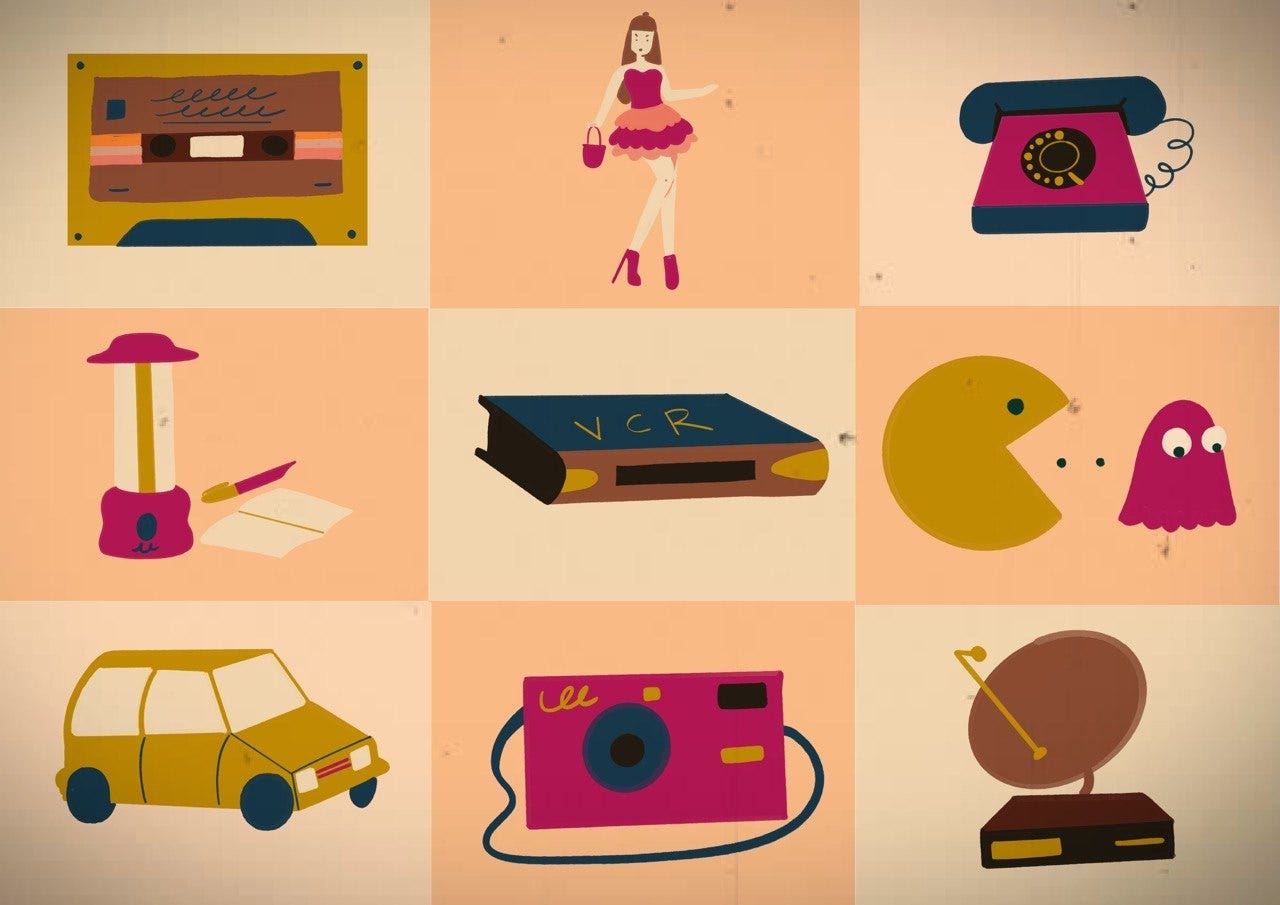
Creative by Anjul D.| The ‘nostalgia edit’ turns everyday objects into collector’s treasures
This is restorative nostalgia in action, and for our generation, it is deeply specific. We once knew these objects intimately. Revisiting it can feel safe in a way the present may not.
Nothing wrong with that, in doses. But going back to Boym, one has to ask: where do you draw the line between visiting and moving back in?
When Does Nostalgia Get Dark?
That line, in fact, is difficult to define. But literature might help explain the difference between reminiscing (healthy) and ruminating (unhealthy).
Jay Gatsby and Devdas are mascots for those who ruminate and refuse to go back. They stay anchored to their past and cannot function in the present.
Compare that with Dorothy from the Wizard of Oz. She does reminisce about her home but snaps back to focus on the task at hand – getting to the Wizard.
Red flags: When nostalgia becomes a problem
In real life though, it is not as stark as Dorothy vs Devdas. The drift is gradual. Watch out for these signs:
The individual no longer just says ‘nothing is as good as it used to be’. They actually believe it.
They withdraw from new experiences because those are not as exciting as their past.
They avoid grief and refuse to process a current loss. Instead, they insist on reliving old memories.
They withdraw from society and frame it as a preference – ‘I just prefer the old crowd’.
They are irritable or contemptuous towards the present, be it new technology, new culture or younger people. That is a sign the person is afraid to let go of their emotional anchors and process the change.
Still confused? Answering this question might help:
‘Does thinking about this memory make me feel grateful or does it make the present feel lesser and inadequate?’
Seek help if the low mood persists, or if nostalgia causes you to get anxious, lose motivation and pull away from the present, instead of informing it.
And here’s why that matters – how you use nostalgia directly shapes how you age.
The Role of Nostalgia in Ageing Healthy
Let’s face it: it’s not easy to grow older. You retire and start questioning your identity and purpose. Your body and mind could decline. Your friends, siblings may move away or pass on. Death is all around you. One would expect older people to be more miserable.
But they are not. In fact, they are often happier than the youth. British researchers attribute this to nostalgia. They studied people aged 18 to 91 years and found that older people who regularly reminisced about the past were happier, had better relationships, and felt more in control of their lives. Those who didn’t engage with their memories lost out on these benefits.
And it follows, doesn’t it, that if you are in control of your past and present life, you are more optimistic about what is to come – a key aspect when it comes to ageing healthy.
The Super-Ager Mindset
Optimism has a big influence on how we age. People who are positive about ageing could live significantly longer - by an average of 7.5 years - than those with negative ones.
According to research from Yale (Becca Levy’s landmark studies) this effect holds even after controlling for health, socioeconomic status, and other variables.
Optimism helps make new memories too. Optimistic people are more likely to seek out new experiences, which means more new memories. They are more socially engaged, which is one of the strongest predictors of cognitive health in later life. They reframe the past with gratitude and approach the future with curiosity rather than dread.
What does this mean for you?
Take a cue from the Irish.
Rather than mourn a dead person, the Irish choose to celebrate them. A funeral is followed by a ‘Wake’ – a party where family and friends gather to indulge in nostalgia, reminisce about the person and share personal anecdotes. They mark the loss but honour the life the person lived.
Do the same with your memories too. Use it to power your future. And to remind you to make new memories.
Invest in future nostalgia
This is surprisingly easy, once we re-orient our minds to looking forward.
Try these to build and record new memories: Indulge in small, deliberate practices like gratitude journaling to record daily events. Pursue one new experience every couple of months. Stay in learning mode and challenge yourself to pick up new skills.
And then, let the compounding effect kick in. Each new memory you create today is future nostalgia. It is also evidence you can lean on that life is worth living.
The Takeaway
Nostalgia is not an enemy. Stagnation is. The most resilient, joyful people in midlife and beyond share a common habit: they honour the past without being owned by it. They understand that the memories they are most grateful for today were once just ordinary Mondays.
So, let’s not merely exist in the past. Let’s not wait for life to slow down to start making memories.
Let’s also try to make the present ‘the best days of [our lives]’🎵
Who did you think of just now? They might want to read this too!
Before You Go
There’s a reason why I chose to co-author this piece with Kaushal K. Mishra, Founder of Aprisio.
Aprisio’s purpose is to create ‘future nostalgia’ by reconnecting its community with their interests. Kaushal is essentially in the business of creating new memories for midlifers. Listen in as he tells us what he’s learnt and how we could go about building ‘future nostalgia’.
A Note:
Never Too Late is becoming more than a weekly newsletter — and 2026 is where that starts. Co-authored pieces like this one are part of how we’re building a community of people who are actively preparing for the 100-year life in India.
The 5 Compounding Choices don’t build themselves. But they’re easier when you’re not building them alone.
If you’re new here, this is your nudge. Subscribe, and I’ll see you every Monday.
Kavita Krishnan
References
Abeyta, A. A., Routledge, C., & Kaslon, S. (2020). Combating loneliness with nostalgia: Nostalgic feelings attenuate negative thoughts and motivations associated with loneliness. Frontiers in Psychology, 11, Article 1219. https://doi.org/10.3389/fpsyg.2020.01219
Hepper, E. G., Ritchie, T. D., Sedikides, C., & Wildschut, T. (2012). Odyssey’s end: Lay conceptions of nostalgia reflect its original Homeric meaning. Emotion, 12(1), 102–119. https://doi.org/10.1037/a0025167
Levy, B. R., Slade, M. D., Kunkel, S. R., & Kasl, S. V. (2002). Longevity increased by positive self-perceptions of aging. Journal of Personality and Social Psychology, 83(2), 261–270. https://doi.org/10.1037/0022-3514.83.2.261
Levy, B. R. (2022). Breaking the age code: How your beliefs about aging determine how long and well you live. William Morrow.
Lowry, P. E., Lench, H. C., & Brosch, T. (2020). The negative interactive effects of nostalgia and loneliness on affect in daily life. Frontiers in Psychology, 11, Article 2185. https://doi.org/10.3389/fpsyg.2020.02185
Moulder, J. (2019). Music, nostalgia, and wellness in the care of older adults. University of Chicago Crown Family School of Social Work, Policy, and Practice.
Sedikides, C., & Wildschut, T. (2022). Nostalgia across cultures. Current Opinion in Psychology, 44, 311–315. https://doi.org/10.1177/18344909221091649
Sedikides, C., & Wildschut, T. (2024). On the nature of nostalgia: A psychological perspective. Emotion Review. https://doi.org/10.1177/17540739241303497
Sedikides, C., Wildschut, T., Arndt, J., & Routledge, C. (2008). Nostalgia: Past, present, and future. Current Directions in Psychological Science, 17(5), 304–307. https://doi.org/10.1111/j.1467-8721.2008.00595.x
Sedikides, C., & Wildschut, T. (2018). Finding meaning in nostalgia. Review of General Psychology, 22(1), 48–61. https://doi.org/10.1037/gpr0000109
Wildschut, T., Sedikides, C., Arndt, J., & Routledge, C. (2006). Nostalgia: Content, triggers, functions. Journal of Personality and Social Psychology, 91(5), 975–993. https://doi.org/10.1037/0022-3514.91.5.975
Zhou, X., Sedikides, C., Wildschut, T., & Gao, D.-G. (2008). Counteracting loneliness: On the restorative function of nostalgia. Psychological Science, 19(10), 1023–1029.https://doi.org/10.1111/j.1467-9280.2008.02194.x
 | A guest post by
|
Beautiful! Got me thinking :) and singing ‘those were the best days of my life’ ♥️